
Your Rights and Next Steps in Washington State Discovering that someone created a fake or AI-generated video of you can…
What Is the Statute of Limitations for Childhood Sexual Abuse in Washington?
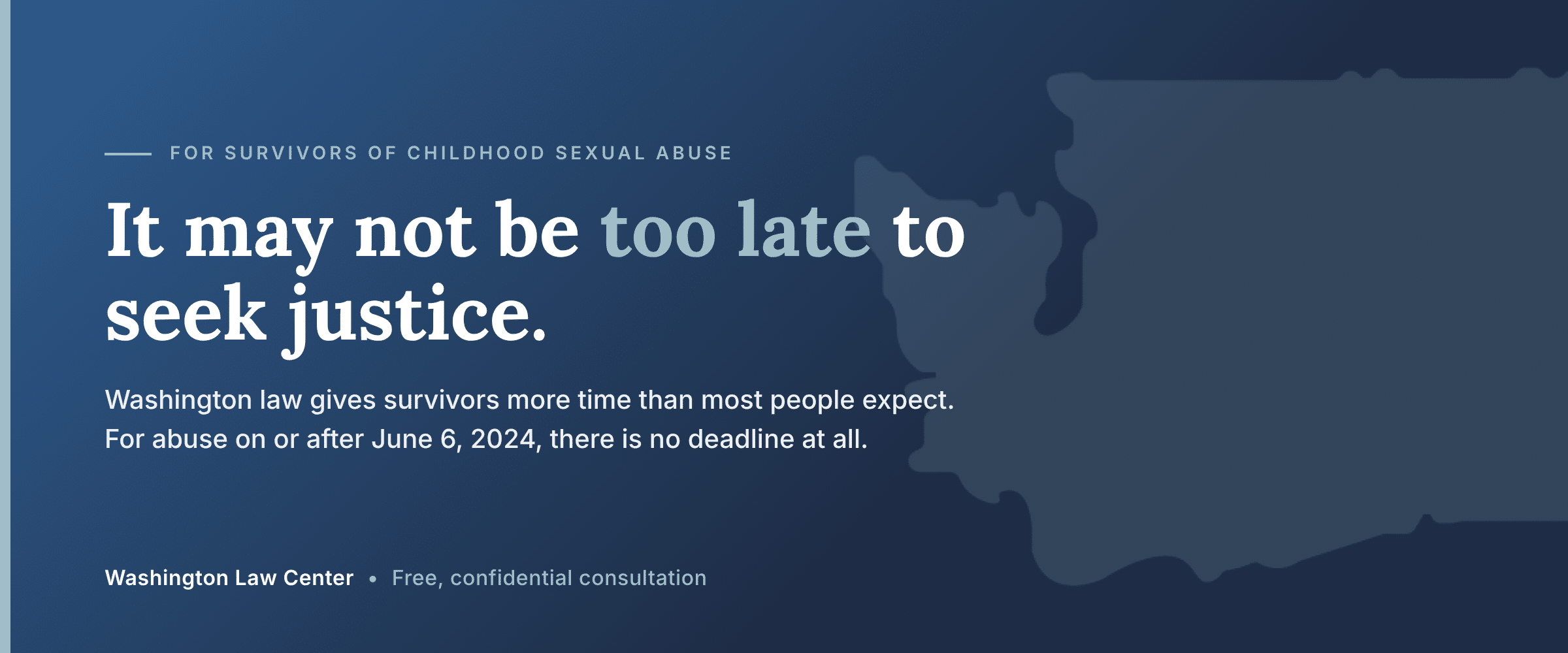
Under Washington’s childhood sexual abuse statute, RCW 4.16.340, the answer depends on when the abuse happened.
| Date of Abuse | Statute of Limitations |
| June 6, 2024 or after | No statute of limitations. A survivor can file a civil claim at any time. (E2SHB 1618) |
| Prior to June 6, 2024 | Three years, but the clock is more flexible than most expect. It often starts only when the survivor connects the abuse to the harm it caused, which can be decades later. |
If you were abused as a child, don’t assume it’s too late. The details below often make the difference.
Washington Gives Sexual Abuse Survivors More Time
Many survivors know they were abused but never connected it to the depression, addiction, relationship struggles, or other harm they live with as adults. Others don’t speak up for years, or have blocked out memories of abuse entirely.
The Washington Legislature recognized this when it wrote RCW 4.16.340. Its findings state that many survivors may not connect the abuse to their injuries until many years later, and that more serious injuries can surface later in life. The Washington Supreme Court has described the law’s purpose as providing “a broad avenue of redress for victims of childhood sexual abuse” (C.J.C. v. Corp. of the Catholic Bishop of Yakima, 1999).
When Does The Three-Year Clock Start?
For abuse before June 6, 2024, a survivor has three years from the latest of these dates:
- The date of abuse.
- The date you knew, or reasonably should have known, that the abuse caused you harm.
- The date you actually realized that the abuse caused the specific harm you’re suing about, even if you knew it caused other harms earlier.
In practice, this means a survivor abused decades ago may still be within the deadline, because the clock is tied to when they made the connection, not to when the abuse happened.
For instance: Someone abused at age 10 in 1995 but started therapy in 2025. In therapy, they connected their depression to the abuse. Their statute starts in 2025, even though the abuse happened 30 years earlier.
The clock never starts before the survivor turns 18. For adult survivors, the third date is usually the one that matters, and Washington courts read it generously:
Knowing about the abuse doesn’t start the clock.
The clock starts when a survivor connects the abuse to the harm. The Legislature expected that survivors may know they are struggling emotionally without understanding why (Wolf v. State, 2023).
What counts is when you actually made the connection.
Unlike the second date, the third has no “should have known” standard (Wolf v. State, 2023).
The defendant has to prove the deadline passed.
When a survivor made the connection is a question of fact, and the party arguing it’s too late bears the burden of proof (Wolf v. State, 2023). An evaluation by a psychologist or psychiatrist can help show when that connection happened.
Situations Where You Likely Still Have Time
Several other rules can help keep a claim alive, even when the abuse happened decades ago.
| Situation: | Why you may still have time: |
| The abuse involved an entity (church, school, foster care, etc.) | The clock for a claim against an entity starts when you connect its conduct to your injury. That can be years after you connected the abuse itself. (Wolf v. State, 2023) |
| You discovered a new, more serious injury | A qualitatively different injury from the abuse can start its own clock, even if you knew about other harm earlier. (Wolf v. State, 2023) |
| The abuse continued after you turned 18 | Later abuse by the same person may be part of the same claim, as long as the claim is based on abuse that began in childhood. (M.R. v. State, 2025) |
| The same person abused you more than once | The clock can be measured from the last act in the pattern. (RCW 4.16.340(2)) |
| Your parents knew about the abuse | A parent or guardian’s knowledge isn’t held against a survivor who was a child at the time. (RCW 4.16.340(3)) |
Not sure which rule applies to you? Talk to us confidentially; it’s free and you don’t have to share everything.
Who Can Be Held Responsible In A Sexual Abuse Case?
A claim can be brought against the abuser, but it can also be brought against entities whose negligence allowed the abuse to happen or continue. This includes:
- Churches
- Schools
- Youth programs
- Foster care
- Department of Social and Health Services (DSHS)
- Department of Children, Youth, and Families (DCYF)
- Child Protective Services (CPS)
- Daycares
- Sports clubs
- State agencies
- Group homes
The Washington Supreme Court confirmed in C.J.C. v. Corp. of the Catholic Bishop of Yakima that the childhood sexual abuse statute covers negligence claims against entities, not only claims against the abuser.
Civil Claims vs. Criminal Charges In Sexual Abuse Cases
A civil claim is separate from a criminal case. Prosecutors bring criminal cases, which can lead to jail or prison. A survivor brings a civil claim, which seeks financial compensation for the harm the abuse caused.
You do not need a criminal conviction or a police report to pursue a civil claim.
How Washington Law Center Can Help
Washington Law Center has extensive experience securing compensation for survivors of childhood sexual abuse, and we handle every case with compassion and discretion.
Do not let the fear of the statute of limitations prevent you from contacting an attorney to discuss your case. Our attorneys have pursued claims for survivors of childhood sexual abuse well into adulthood. In one case, our client was nearly 60 years old. If you were sexually abused in Washington, or by a resident of Washington, you very likely have a legitimate claim that entitles you to compensation and Washington Law Center can help.
Contact Washington Law Center for a free, confidential consultation.
Disclaimer: This is general information, not legal advice. Every case depends on its specific facts, and the law can change, so please speak with an attorney about your situation.
Frequently Asked Questions About Washington’s Sexual Abuse Statute of Limitations
Timelines vary by court and complexity but early resolution is sometimes possible.
At Washington Law Center, your consultation will be handled in the way that makes you feel most comfortable. You can take time to write out your story, meet with us in person, connect virtually, or speak from the comfort of your home. Our priority is creating a safe space where you can share your story in the way that works best for you. The consultation is free and confidential, and you’re under no obligation to move forward.
Yes. Many survivors have a criminal record because of struggles linked to the trauma they experienced. That connection is not your fault, and it should not excuse the abuse or prevent you from pursuing a claim.
The consultation is free and representation is on a contingency fee basis. So you don’t pay attorney fees unless we recover compensation for you.
That’s common, and should not stop you from reaching out. Washington’s Legislature recognized that survivors may block out memories of abuse. You don’t need to remember every detail to talk to an attorney.
Yes. Children can’t legally consent to sexual contact with adults. Many survivors believed it was a real relationship because that is how grooming works. An abuser builds trust, gives special attention, and makes the abuse feel normal or even wanted. None of that shifts the blame and we can talk it through with you confidentially.
ABOUT THE AUTHOR:
Ashton Dennis
Ashton Dennis is a litigation and trial attorney at Washington Law Center focused on representing individuals and families who have suffered a serious personal injury or wrongful death. He was named one of the “Top 40 Under 40” by the National Trial Lawyers of Washington State and one of the “Premier 100” trial attorneys by the American Academy of Trial Lawyers in Washington. Click here to learn more about Ashton.

Related Posts

Comments (0)